
SEO for a personal injury lawyer means winning three things at once: a Google Business Profile strong enough for the map pack, practice area and location pages matching how injured people search, and a site that loads fast enough on mobile to be tapped before they hit back. Done properly on a newer domain, a realistic first year is organic clicks roughly tripling, at a cost per click far below the $150 to $400 the same terms cost in Google Ads.
That last figure is why this niche rewards doing it properly. Legal has the highest average cost per click of any industry, personal injury sits at the top of legal, and the gap between a paid click and an organic one is wider here than almost anywhere in marketing.
Last updated 8 September 2026.
Why personal injury SEO is not generic SEO
It is YMYL. Google classifies legal content as Your Money or Your Life and holds it to a higher standard for experience, expertise, authoritativeness and trust. An unsigned article on limitation periods will struggle however well written. The same piece under a named attorney with bar admission and Person structured data has a chance.
The search is urgent and mobile. This separates personal injury from every other practice area. Someone searching “car accident lawyer near me” is often on a phone, at the roadside or in a hospital waiting room, within hours of the accident. They are not researching. They will call one or two firms and stop.
The competition is funded. High case values mean competitors spending real money. That raises the bar, but firms ignoring unglamorous work like page speed leave room a smaller firm can take.
SEO versus paid ads, with the actual numbers
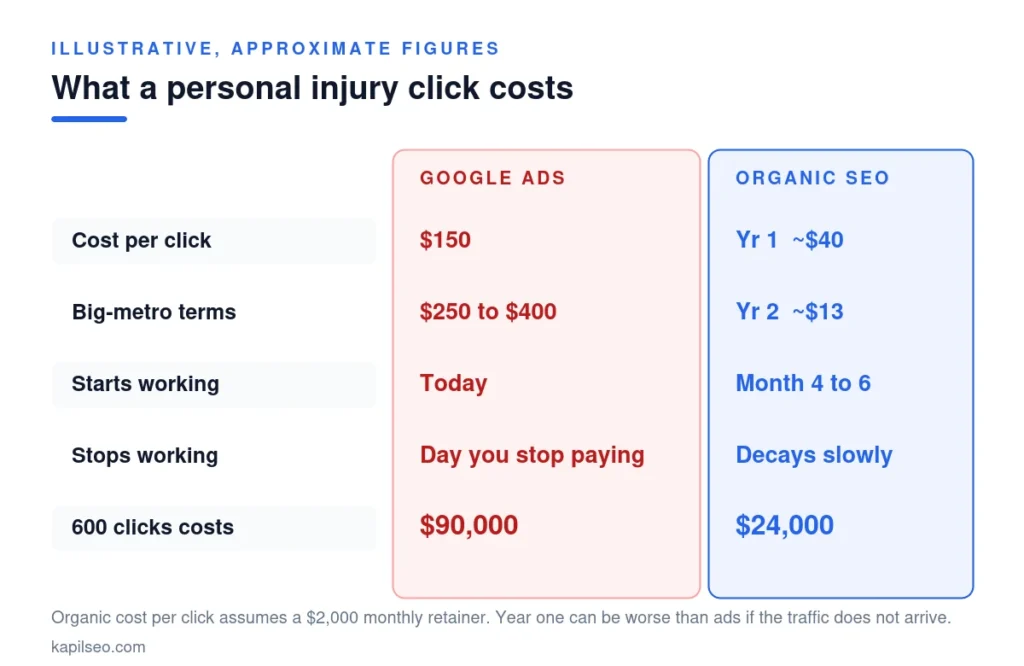
Most articles say SEO is better long term and leave it there. Here is the arithmetic. These figures are illustrative. Replace them with your own. Personal injury terms run roughly $80 to $150 per click in mid-market cities and $150 to $400 in major metros, with truck accident and brain injury variants reported above $400.
Take a $150 click. Spend $15,000 and you buy 100 clicks. At a 6% enquiry rate and a 15% sign rate, that is roughly one signed case. On a $100,000 settlement at a one-third contingency, that case is worth about $33,000 in fees. So $15,000 of ads returns $33,000. That works, and it is why firms do it. But it stops the moment you stop paying, and the hundred-and-first click costs the same $150 as the first.
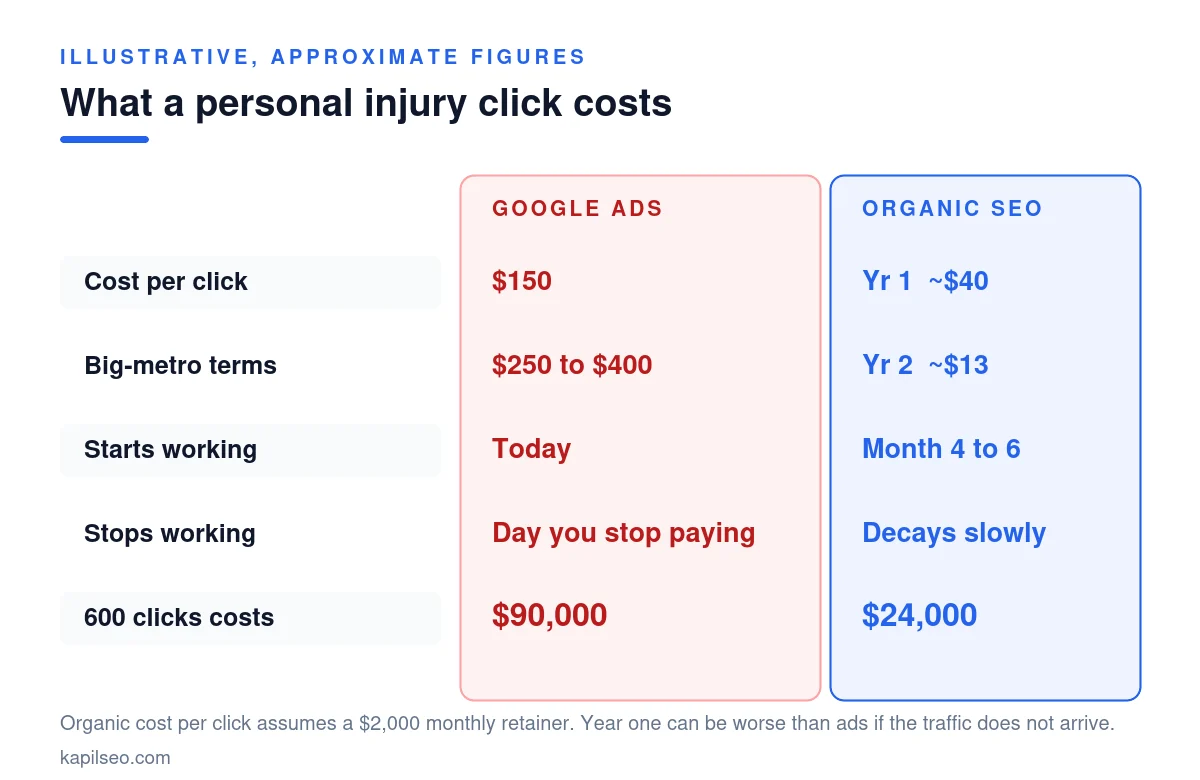
The organic side: a $2,000 retainer is $24,000 a year. If that produces 600 organic clicks across year one, allowing for the ramp, the effective cost is around $40 a click. In year two the same $24,000 against 1,800 clicks is about $13. Buying those same 600 clicks on Google Ads would cost $90,000.
The honest counterpoint: ads produce a case this week and SEO does not. If your caseload is empty, run ads. The strongest position is ads funding the wait while organic is built, then cutting paid spend as organic takes the same queries.
Keyword strategy: two very different searchers
Informational. “How long do I have to file a car accident claim”, “what is my back injury claim worth”, “who pays medical bills after a car accident”. High volume, low immediate intent. Write these with the state or province named, because limitation periods and fault rules are jurisdictional and a generic answer is wrong for most readers. They rarely sign a case directly, but they build topical depth and are your main route into AI Overview citations.
Transactional. “Car accident lawyer near me”, “personal injury attorney [city]”, “truck accident lawyer free consultation”. Lower volume, enormous value, and the ones carrying the $150 to $400 paid price tag. These get practice area and location pages, not blog posts, and they need the map pack working.
On-page work that actually matters
Practice area pages. One per injury type, never a combined services page. Car accidents, truck accidents, slip and fall, workplace injury and medical negligence are separate searches with separate competition. Answer the three questions every injured person has: what it costs, how long it takes, what happens first. Say plainly that you work on contingency with no fee unless they win, because that is the objection stopping the call.
Location pages. Only for cities where you genuinely practise, with real content about local courts. Ten templated city pages with the name swapped gets the set treated as thin content.
Attorney bios. The highest-leverage YMYL fix available. Bar admission and year, case types, verdicts where you may publish them. Add Person structured data and link every article to its author.
Above the fold. The phone number, a tap-to-call button and the free consultation promise belong in the first mobile screen, not after a hero image and a mission statement.
Mobile speed, where personal injury differs from everything else
Most guides list Core Web Vitals in a checklist and move on. For personal injury it deserves its own section, because the traffic pattern is unusual: one visit, on a phone, under stress, with no second attempt.
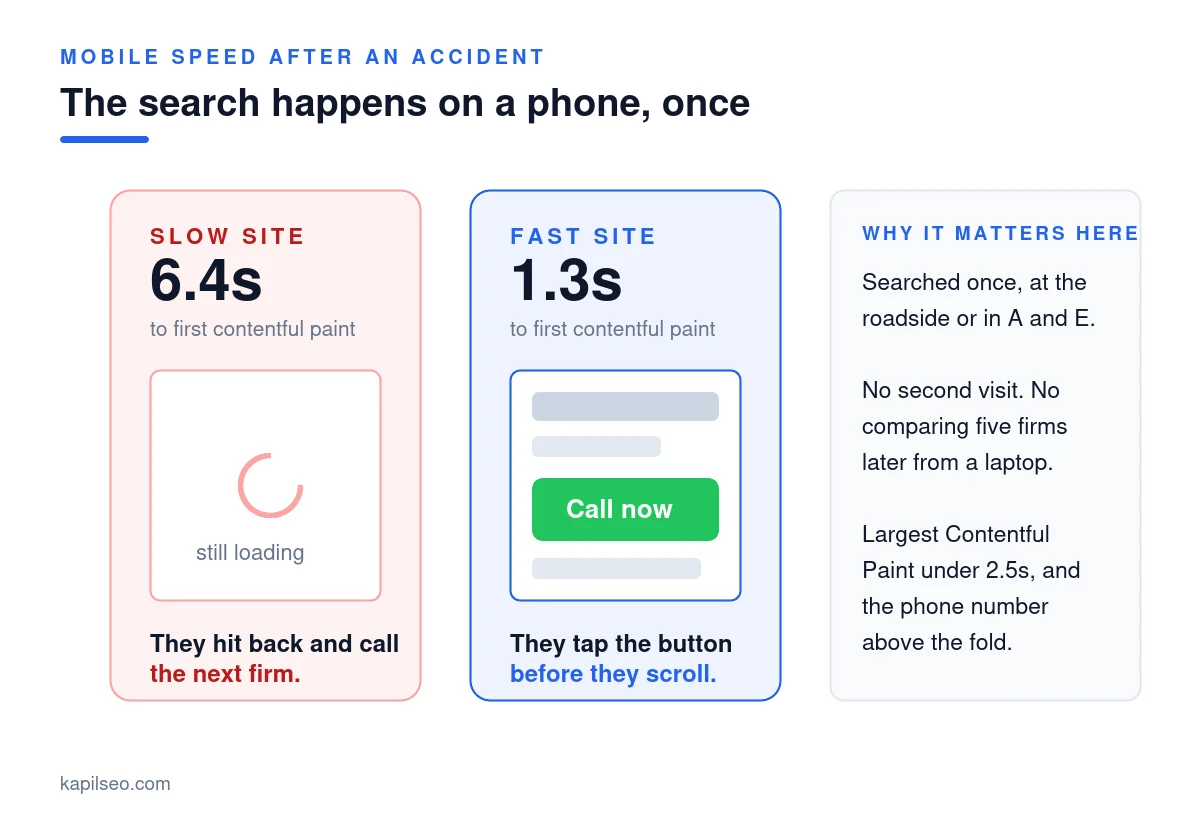
Someone comparing accountants will reopen your site from a laptop that evening. Someone just rear-ended will not. If your page takes six seconds to paint on a mid-range phone, they go back and call the next firm, and it never shows up as a lost case because they never arrived.
Target Largest Contentful Paint under 2.5 seconds, tested on throttled mobile data rather than office wifi. The usual culprits are an oversized hero image, a chat widget loading before the content, and three tracking scripts in the head. Often one afternoon of work, and it moves rankings and conversion at once, which is rare.
Local SEO: three layers, not one
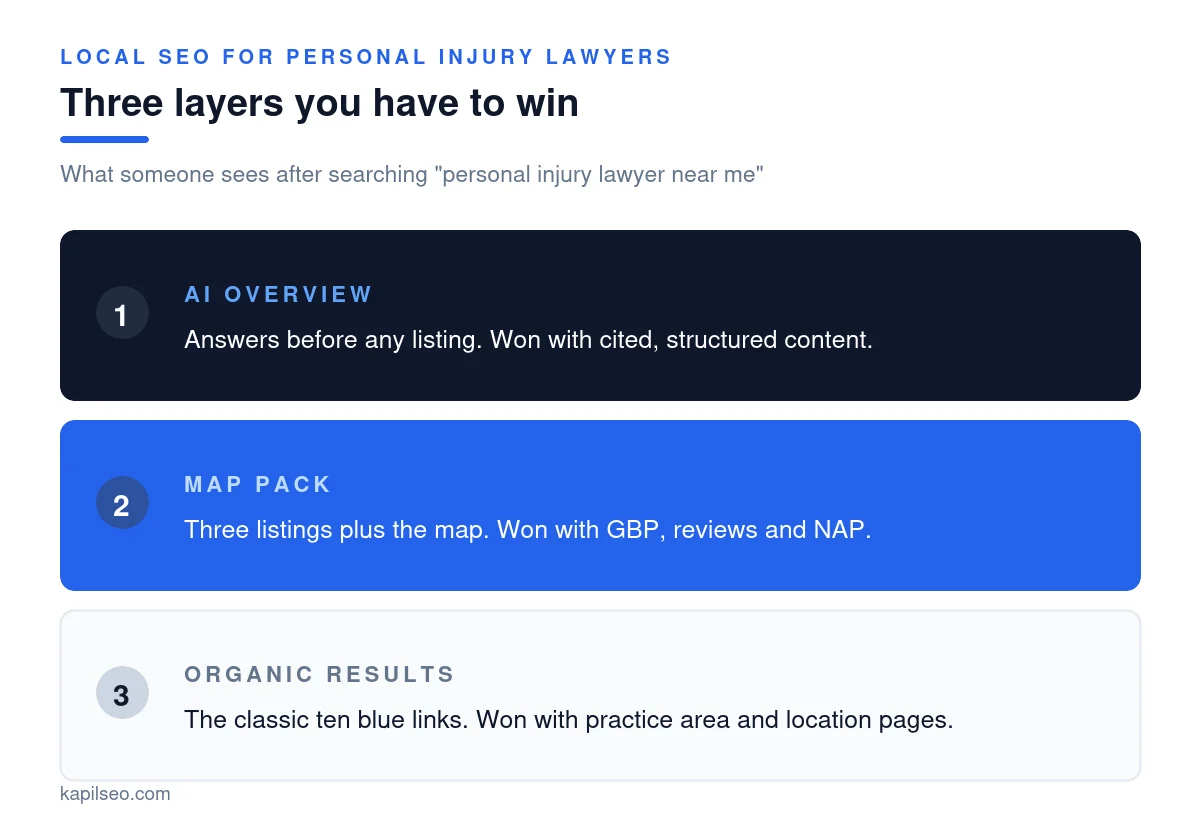
A search for “personal injury lawyer near me” returns an AI Overview, then a map pack, then organic results. Each is won differently and you need all three.
Google Business Profile. Primary category “Personal injury attorney”, not the generic “Lawyer”. Services listed separately, real photographs, hours, service areas and a booking link. Then reviews, which matter more here because someone choosing a firm in a hospital car park is reading them as their entire due diligence. Answer them all, including the difficult ones.
Legal directories. Avvo, FindLaw, Justia and your state or provincial bar listing. Most of those links are nofollow, which people use as a reason to skip them. Wrong reason. They matter because prospects browse them, and because consistent listings act as a verification signal for local search independently of link equity.
NAP consistency. Name, address and phone identical everywhere, down to “Suite 200” versus “Ste 200”. Firms that have moved or merged usually have three versions circulating. Dull work, reliable results.
Getting cited in AI Overviews
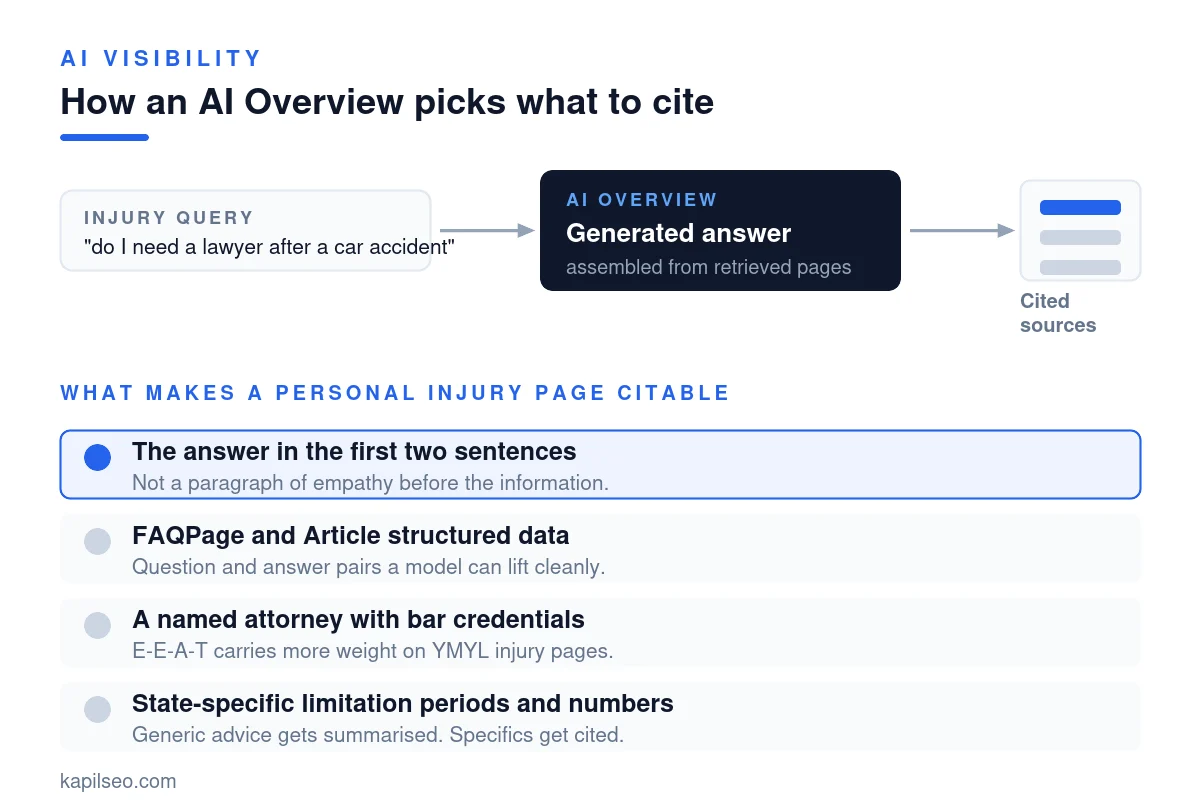
Legal is the worst-affected category for AI Overviews, with roughly 78% of legal queries returning one according to SE Ranking’s research. For personal injury that hits the informational half hardest, because “how long do I have to file a claim” is exactly what a generated answer handles well. The response is not to stop writing those pages, it is to write them so that when the answer appears, your firm is the source named in it. Four things move this:
- Answer in the first two sentences. Injury content often opens with a paragraph of sympathy before any information. Lead with the answer, then the empathy.
- Structured data. FAQPage and Article schema, plus Person schema on bios. Question and answer pairs extract cleanly.
- Named, credentialed authors. The E-E-A-T work that helps YMYL rankings helps citation selection, since both identify who is qualified to answer.
- State-specific specifics. Limitation periods, comparative fault rules, damage caps, settlement ranges. Generic advice gets absorbed with no attribution. Specifics get cited.
Track it by running the same fifteen to twenty client questions through ChatGPT, Google’s AI Mode, Gemini and Perplexity monthly, logging whether the firm was named and which pages were cited. About forty minutes, and the only consistent measurement available.
What this looked like on a real legal client
A Canadian legal services firm on a newer, lower-authority domain, building organic visibility from close to nothing in a competitive local market, with AEO and GEO tracked from the start.
Comparing the most recent three months against the three before, Search Console showed clicks rising from 268 to 841 and impressions from 22.4K to 72.5K. Both roughly tripled. In GA4 across the same work, total sessions rose 82%, engaged sessions rose 133%, and organic sessions rose 75%.
The number worth flagging is the one that got worse. Average position moved from 9.8 to 13.2. That happens when a site goes from ranking on a narrow query set to a much wider one, most of it new and positioned lower, dragging the blended average down while clicks triple. Average position is a mix, not a score. If a report shows every metric improving, ask which ones were excluded.
On the AI side, tracked monthly, the firm went from no presence to being named and cited across ChatGPT, Gemini, Google’s AI Mode and AI Overviews, with citations appearing weeks before rankings caught up. The month-by-month figures sit with my other work in the case studies.
One caveat I will not skip: this was a legal services firm, not a dedicated personal injury practice. The mechanics transfer, since the YMYL constraints, local intent and AI Overview pressure are the same, but I will not claim a personal injury result I do not have. The same engagement appears in my post on SEO for family lawyers.
Do it yourself or hire? The math is harsher here
Doing this properly takes around ten hours a month: content, profile maintenance, directory work, speed monitoring and the AI tracking above.
For most lawyers you price that against a billable rate. Personal injury runs on contingency, so the comparison is less forgiving. Those ten hours come out of case work and intake calls. If a signed case is worth $33,000 in fees, ten hours a month on SEO instead of intake only has to cost you one case a year to have been the most expensive decision in your marketing budget.
Against that, a freelancer in a Western market runs roughly $800 to $2,500 a month, a specialist agency $2,500 to $10,000, and an experienced freelancer working remotely from a lower-cost market $300 to $1,500. A year of good SEO costs less than one signed file.
The honest exception is a new practice with an empty calendar. If you are not turning away work, your time is genuinely cheaper than a retainer, and doing it yourself while you learn is the right call.
One part cannot be outsourced. The legal substance has to come from a lawyer, because that is the expertise Google assesses on YMYL pages. The workable arrangement is one to two hours of attorney time a month on substance and review, with everything else handled elsewhere. The general version of this calculation is in is SEO worth it, and the ongoing side is what my SEO services cover.
Frequently asked questions
How much does SEO for a personal injury lawyer cost?
Roughly $800 to $2,500 a month with a freelancer, $2,500 to $10,000 with a specialist agency, and $300 to $1,500 with an experienced freelancer in a lower-cost market. Personal injury sits at the higher end because the competition is well funded. Set any of those against one signed case, worth more than a year of the work.
Is SEO better than Google Ads for personal injury?
Cheaper per click over time, slower to start. Paid clicks on injury terms run $150 to $400 in major metros and cost the same forever. Organic works out around $40 a click in year one and closer to $13 by year two. Run ads if you need cases this month, and build organic alongside to cut paid spend later.
Does site speed really affect personal injury cases?
More than in most niches, because the search happens once, on a phone, often within hours of the accident, with no second visit later. A six-second load sends someone back to call another firm, and that loss never appears in analytics because they never landed. Target Largest Contentful Paint under 2.5 seconds on throttled mobile data.
Will AI Overviews take my personal injury traffic?
They already take a share of informational traffic, at roughly 78% of legal queries. What they do not take is the transactional search. Someone choosing who to call still wants a firm, a phone number and reviews, decided in the map pack and on your site. Expect informational clicks to fall, protect the commercial pages, and work on being the cited source.
About the author. Kapil Lodhi is an SEO and AI SEO specialist in Indore, India, with over four years of hands-on experience across technical SEO, content strategy, link building and local SEO for clients in India, the United States and Canada. He ran the organic and AI visibility work for the Canadian legal services firm whose figures appear above.