
A Google Ads for doctors SEO outline is a single plan that splits search between two jobs: paid ads for patients ready to book today, and organic pages for patients still describing their symptoms. It has eight parts: patient value and goals, the keyword split, campaign structure, a compliance check, landing pages, conversion tracking, local presence, and AI visibility.
The part almost every version of this guide leaves out is the compliance check, and it is the one that can get a practice’s account limited. Health is a sensitive category in Google Ads, which means the audience tactics that work for a plumber or a law firm, remarketing above all, are simply not available to you.
Last updated 20 September 2026.
What a Google Ads for doctors SEO outline should cover
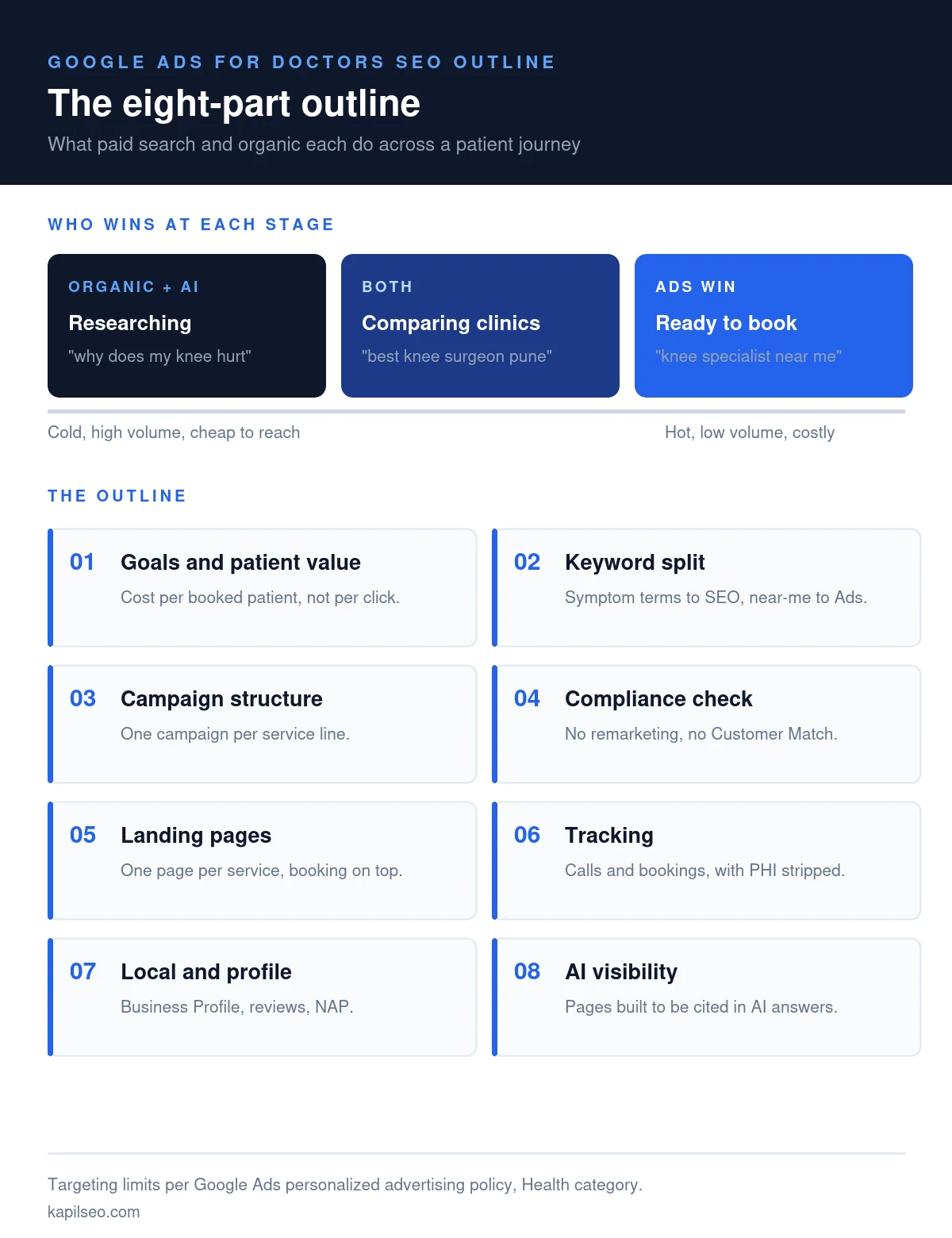
Eight sections, in the order you should build them. The order matters, because three of them can invalidate work you have already paid for if you leave them to the end.
- Patient value and goals. What one new patient is worth over a year, and what you can afford to pay to acquire one. Every later decision hangs on this number.
- The keyword split. Which searches go to ads, which go to organic pages, and which get both.
- Campaign structure. One campaign per service line, tight ad groups, negatives from day one.
- Compliance check. Which audiences you are allowed to use, and what must never reach Google.
- Landing pages. One page per service, with booking visible without scrolling on a phone.
- Conversion tracking. Calls and bookings recorded as conversions, with no patient data attached.
- Local presence. Google Business Profile, reviews, and consistent listings.
- AI visibility. Pages written so an AI answer names your practice as the source.
The split rule: which channel gets which keyword
Patients search in three distinct modes, and the mistake is treating them as one funnel to be bought.
Researching symptoms. “Why does my knee hurt going down stairs”, “how long does vertigo last”, “is a lump under the jaw serious”. High volume, low intent, and expensive to buy because most clicks will never become patients. These belong to organic content, written by or reviewed by a named clinician. They rarely fill a diary directly. What they do is build the authority that helps your service pages rank, and they are your main route into AI answers.
Comparing clinics. “Best knee surgeon in Pune”, “orthopaedic clinic reviews”. Both channels earn their place here. Ads get you in front of the shortlist, organic and your reviews decide whether you survive it.
Ready to book. “Knee specialist near me”, “walk in clinic open now”, “same day appointment dermatologist”. Low volume, high value, and this is where ads earn their cost. You cannot wait six months for organic to reach these, and the map pack is usually sitting above the organic results anyway.
The rule I use: if the search names a condition, it goes to content. If it names a service, a place, or a time, it goes to ads. That single test resolves most keyword arguments in about ten seconds.
What Google will not let a medical advertiser do
This is the section that separates a plan written for doctors from a plan written for any local business and relabelled.
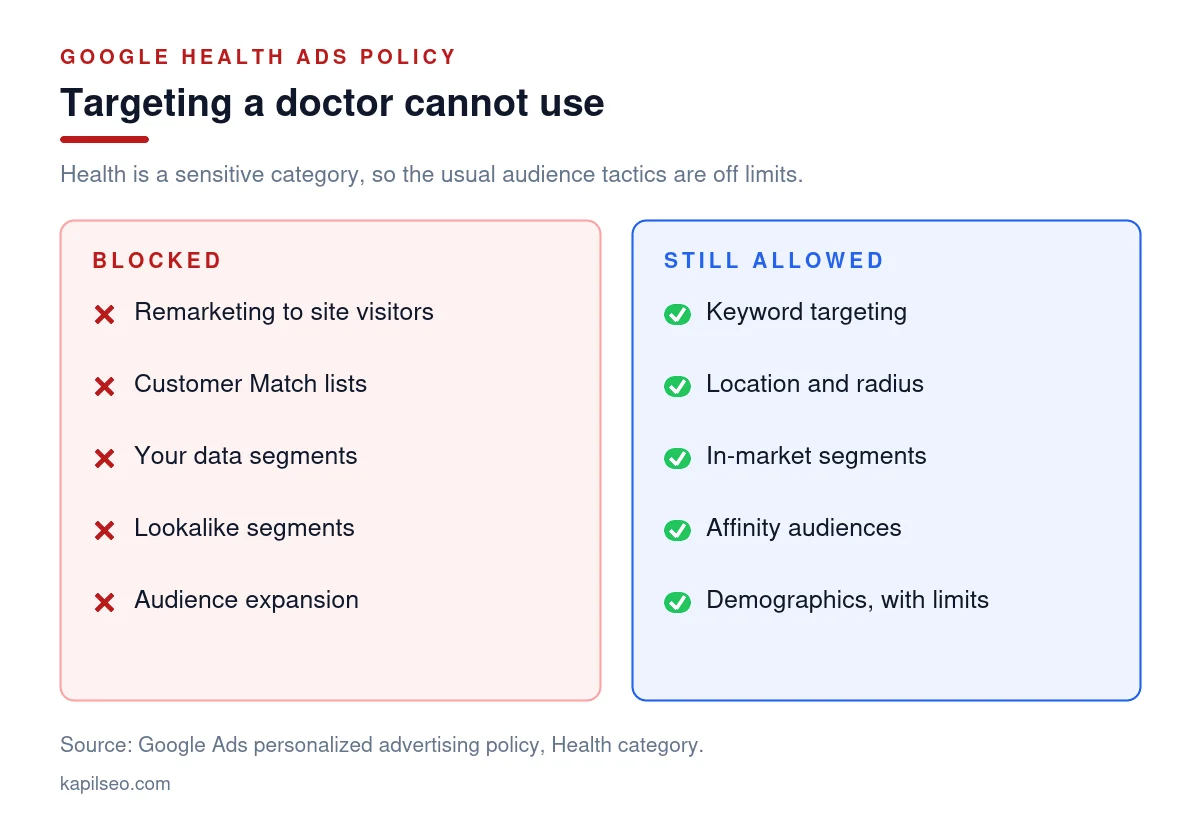
Google treats health as a sensitive category under its personalised advertising policy. For health content, which includes physical and mental health conditions and the products, services and procedures used to treat them, these are not available:
- Remarketing, or any advertiser-curated audience built from your own site visitors
- Customer Match, so no uploading a patient list
- Your data segments
- Lookalike segments
- Audience expansion
What you keep is keyword targeting, location and radius, predefined Google audiences such as in-market and affinity segments, and demographics with some limits. That is enough to run a strong campaign, but it means any agency proposal promising to “retarget everyone who visited your treatment page” is describing something you are not permitted to do.
The second constraint is patient data. Google does not sign a Business Associate Agreement for Google Ads, so protected health information must never reach it. In practice that means three habits: strip query strings that carry names, emails or appointment details before they hit analytics; never name a conversion action after a condition in a way that ties it to an individual; and check that your booking system is not passing patient details into the URL of the thank-you page. The leak is almost always in the thank-you page URL.
Some categories, addiction services among them, also require Google certification before they can advertise at all. Check your specialty against the healthcare policy before you build anything.
Campaign structure for a practice
One campaign per service line, not one campaign for the whole practice. A dermatology clinic running acne, mole checks and cosmetic work in a single campaign cannot control where the budget goes, and the highest-volume service will quietly eat the others.
Inside each campaign, keep ad groups tight enough that the ad can repeat the search phrase honestly. Separate branded terms into their own campaign so competitors bidding on your name do not distort the numbers you report.
Build the negative keyword list before launch, not after the first invoice. For medical accounts the reliable early wasters are “jobs”, “salary”, “courses”, “free”, “near me open now” when you are not, and the names of conditions you do not treat. Add “how to” and “home remedy” unless you genuinely want that traffic.
Landing pages and tracking that does not leak
Send every ad to a page about that one service. Not the homepage. A patient who clicked “knee specialist” should see knee, not a carousel of your whole practice.
On mobile, which is where most of this traffic arrives, the phone number and booking button belong in the first screen. Patients searching for care are often in discomfort and are not scrolling past a mission statement to find your number. The same urgency logic applies in other high-value local niches, which I wrote about in more detail for personal injury firms, where the search also happens once, on a phone, under pressure.
For tracking, count what a practice manager actually cares about: calls over 60 seconds, completed booking forms, and direction requests. Clicks and impressions are diagnostics, not results. Report the cost per booked patient every month against the number from step one, and the whole argument about whether the ads are working answers itself.
Getting the practice named in AI answers
Health questions are exactly the kind of query AI Overviews handle, because they are informational and repeatable. That hits the symptom-research half of your content hardest: the reader gets an answer without visiting anyone’s site. The response is not to stop publishing those pages, it is to write them so that when the answer appears, your practice is the source it names.
- Answer in the first two sentences. Medical content tends to open with reassurance before information. Lead with the answer, then the context.
- Name a real clinician. Author and medical reviewer, with qualifications, registration number and a linked bio page. This is the strongest quality signal you control on health content, and both ranking and citation systems are trying to work out who is qualified to answer.
- Use Physician, MedicalClinic and FAQPage structured data so the facts about your practice and your answers are machine readable.
- Be specific. Recovery times, what a consultation costs, what the procedure involves, which conditions you do not treat. Generic advice gets absorbed into a summary with no attribution. Specifics get cited.
Track it monthly by running the same fifteen to twenty patient questions through the major assistants and logging whether the practice is named and which pages are cited. I have run this for a legal client in a similarly regulated field, where AI citations appeared several weeks before the rankings caught up, and the month-by-month figures are in my case studies.
What it costs, and which channel to start first
These figures are illustrative. Replace them with your own. Medical clicks are not cheap, commonly in the range of a few dollars for general practice terms to well over twenty for competitive surgical and cosmetic searches in major cities.
Work it backwards instead of forwards. If a new patient is worth 25,000 rupees over the first year, and one in four enquiries books, and one in twenty clicks enquires, then twenty clicks produce one enquiry and eighty clicks produce one patient. At 60 rupees a click that patient costs 4,800 rupees to acquire, which is comfortable. At 300 rupees a click it costs 24,000, which is not. The arithmetic decides whether ads are viable for your specialty long before anyone opens an ad account.
Which to start first depends on your diary, not on principle. An empty diary means ads, because they produce enquiries this week and organic does not. A full diary means organic, because you are buying the next two years cheaply. Most practices should run both, with ads funding the wait while the content and local presence build. I have set out that trade-off with the fuller arithmetic in is SEO worth it, and the ongoing work is what my SEO services cover.
Frequently asked questions
What should a Google Ads for doctors SEO outline include?
Eight parts: patient lifetime value and goals, the keyword split between paid and organic, campaign structure by service line, a compliance check against Google’s health policy, one landing page per service, conversion tracking that records calls and bookings without patient data, local presence through Google Business Profile and reviews, and AI visibility work so the practice is cited in AI answers. Build the compliance check before the campaigns, not after.
Can doctors use remarketing in Google Ads?
No. Google classifies health as a sensitive category, and advertiser-curated audiences, which includes remarketing lists built from your own site visitors, are not available for health-related advertising. Customer Match, your data segments, lookalike segments and audience expansion are also unavailable. Keyword targeting, location, in-market and affinity segments and demographics remain.
Should a medical practice run Google Ads or SEO first?
Whichever your diary calls for. Ads if appointments are empty now, because they deliver enquiries within days. SEO if you are near capacity, because it lowers your acquisition cost over the following year. Running both is the strongest position, with ads covering the four to twelve months organic takes to build on a newer site.
How do I keep patient data out of Google Ads and Analytics?
Google does not sign a Business Associate Agreement for Google Ads, so no protected health information may be sent to it. Strip query strings containing names, emails or appointment details before they reach analytics, avoid conversion action names that tie a condition to an individual, and check the URL of your booking confirmation page, which is where the leak almost always is.
Do AI Overviews affect searches for doctors?
They affect the symptom and condition questions most, since those are informational and easily summarised. They affect “near me” and booking searches far less, because someone choosing a clinic still wants a name, a phone number and reviews, and that happens in the map pack and on your site. Expect informational traffic to fall, protect the service pages, and work on being the source the answer cites.
About the author. Kapil Lodhi is an AI SEO consultant in Indore, India, with over four years of hands-on experience across technical SEO, content strategy, link building and local SEO for clients in India, the United States and Canada, including work in regulated fields where compliance shapes what marketing is allowed to do.