
SEO for a family lawyer comes down to four things: practice area and location pages that match how people actually search, a Google Business Profile built properly, credible attorney bios that satisfy Google’s stricter standards for legal content, and content that answers the questions people ask before they are ready to hire. Done well on a newer domain, a realistic first year is a two to three times increase in organic clicks and a steady flow of consultation enquiries, not a number one ranking for “divorce lawyer” in a major city.
The part most guides skip is that family law is one of the hardest niches Google polices. It is Your Money or Your Life content, so the bar for demonstrated expertise is higher than in almost any other industry, and roughly 78% of legal queries now return an AI Overview before anyone sees your listing. Both of those change what you should build.
Last updated 7 September 2026.
Why family law SEO is not generic SEO
It is YMYL. Google classifies legal advice as Your Money or Your Life, content that could affect someone’s finances, safety or legal standing, and holds it to a higher standard for experience, expertise, authoritativeness and trust. In practice an unsigned blog post about custody law will struggle no matter how well written it is, while the same article under a named, credentialed lawyer has a chance.
The buying window is short and local. Someone searching “divorce lawyer near me” is often hiring within a week. They are not comparing twelve firms, they are calling two or three from the map pack. That makes local SEO the highest-leverage work available to most firms, ahead of blogging.
AI Overviews sit above everything. With around 78% of legal queries triggering one, per SE Ranking’s research, the informational half of your content is increasingly being read inside Google rather than on your site. That does not make it worthless, but it changes what the content is for, which I come back to below.
Keyword strategy: two audiences, not one
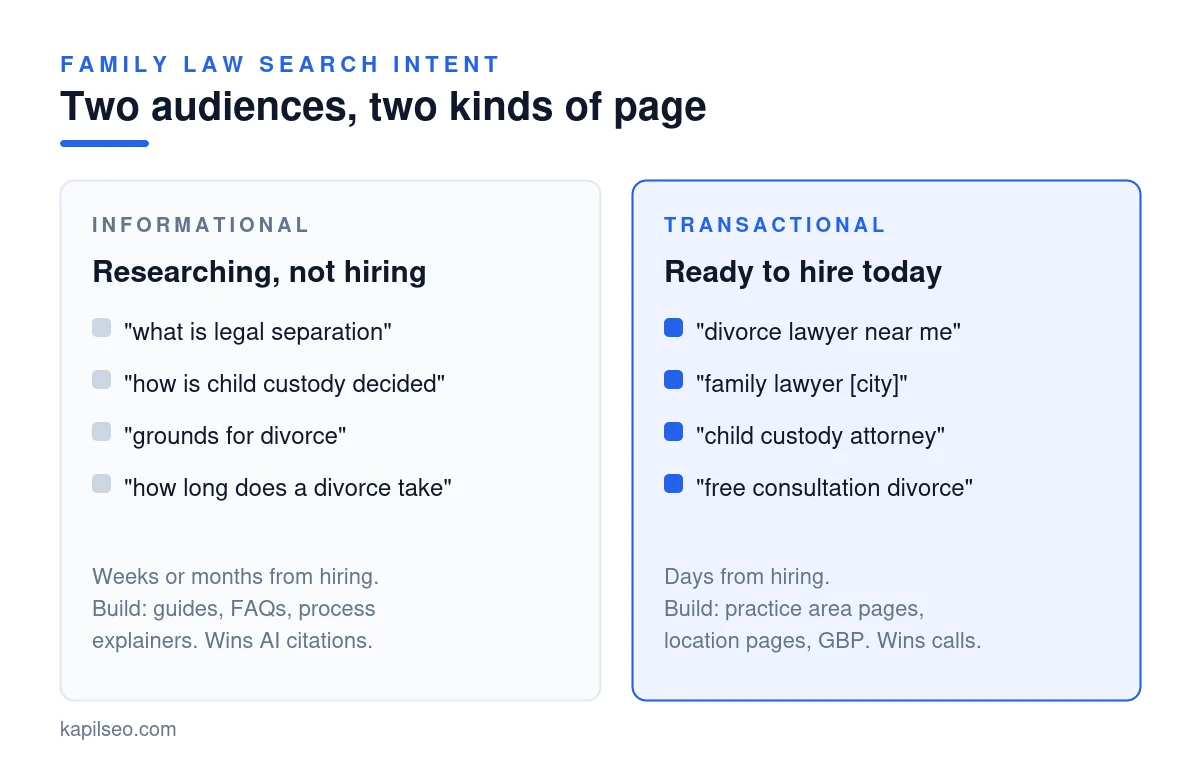
The single most common mistake I see on family law sites is treating every keyword as the same kind of opportunity. They split cleanly into two groups that need different pages.
Informational queries: people researching
“What is legal separation”, “how is child custody decided”, “grounds for divorce”, “how long does a divorce take”, “do I have to go to court for a divorce”. These have volume and low commercial intent. The person may be months from hiring anyone, and sometimes they are researching on behalf of a friend.
Build these as genuine explainers with the jurisdiction in the title, because family law is provincial or state law and a generic answer is wrong for most readers. They rarely convert directly. What they do is build the topical depth that helps your commercial pages rank, and they are your main route into AI Overview citations.
Transactional queries: people ready to hire
“Divorce lawyer near me”, “family lawyer Mississauga”, “child custody attorney free consultation”, “best divorce lawyer in [city]”. Lower volume, far higher value. One of these converts at many times the rate of an informational visitor.
These do not get blog posts. They get practice area pages and location pages, and they need your Google Business Profile working, because most of these searches return a map pack before any organic result.
If you only have budget for one, start with transactional. Informational content without commercial pages behind it produces traffic and no clients, which is how firms conclude that SEO does not work.
On-page work, page type by page type
Practice area pages. One page per service, never a combined “Our Services” page listing eight things. Divorce, child custody, spousal support, property division and mediation each need their own URL, because each is a separate search. The specific optimization that matters most: answer the three questions every prospect has, which are what it costs, how long it takes, and what happens first. Most firm pages answer none of them, and the firms that do get the call.
Location pages. Only build one for a city where you genuinely practise, with real content: the courthouse you appear at, the local process, cases you handle there. Ten near-identical city pages with the name swapped is the fastest way to get the set treated as thin content. Two real ones beat ten templated ones.
Attorney bio pages. The most underrated pages on a law firm site and the most important for YMYL. Bar admission and year, law school, years in family law specifically, notable case types, publications, memberships. Add Person structured data, then link every article that lawyer wrote to their bio and back. This is the clearest expertise signal you control and usually the cheapest fix available.
Local SEO, where most family law cases actually come from
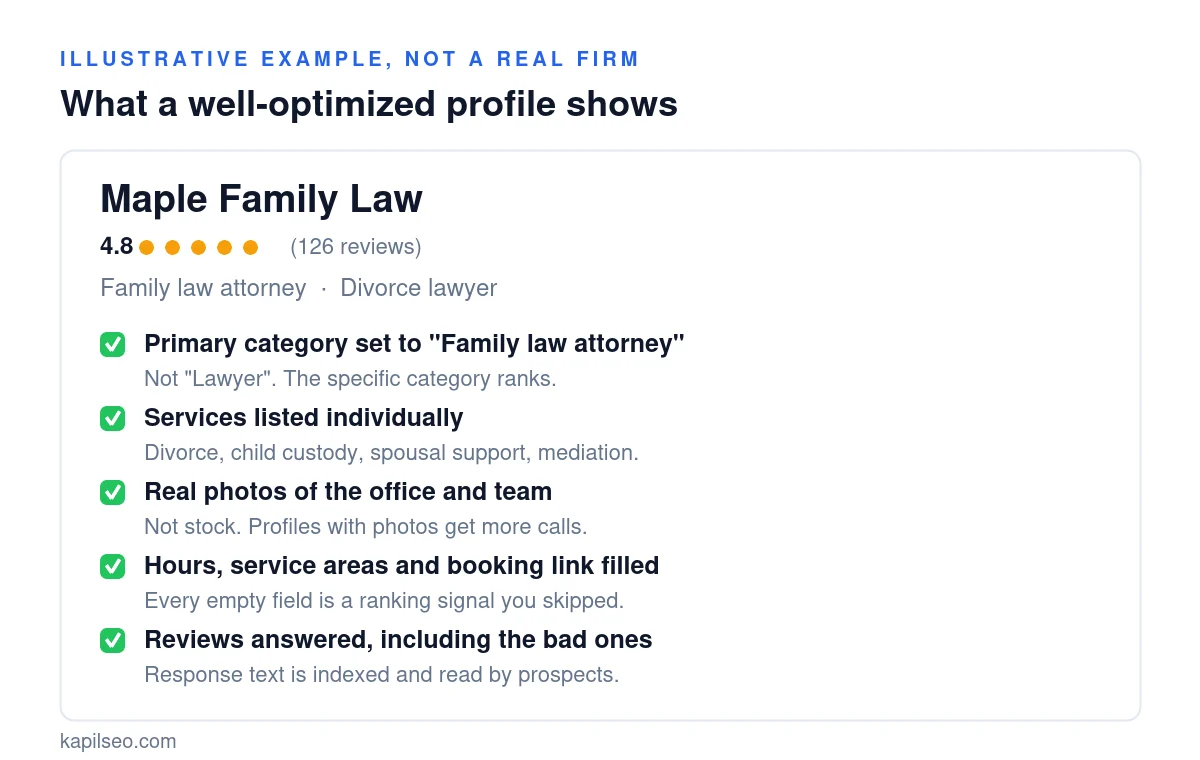
Google Business Profile. Set the primary category to “Family law attorney” rather than the generic “Lawyer”, list each service separately, add real photographs of the office and the people, fill in hours and service areas, and connect a booking link. Every empty field is a signal you chose not to send. Then answer reviews, including the difficult ones, because that text is visible to every prospect reading them.
Legal directories. Avvo, FindLaw, Justia, Lawyers.com and your provincial or state bar listing. Most of these links are nofollow, which people use as a reason to skip them. That is the wrong reason. They matter because prospects genuinely browse them, and because consistent listings across directories act as a verification signal for local search independently of link equity.
NAP consistency. Name, address and phone identical everywhere, down to whether you write “Suite 200” or “Ste 200”. Firms that have moved offices or rebranded usually have three versions circulating. Fixing that is dull, unglamorous work that reliably moves local rankings.
Getting cited in AI Overviews and AI assistants
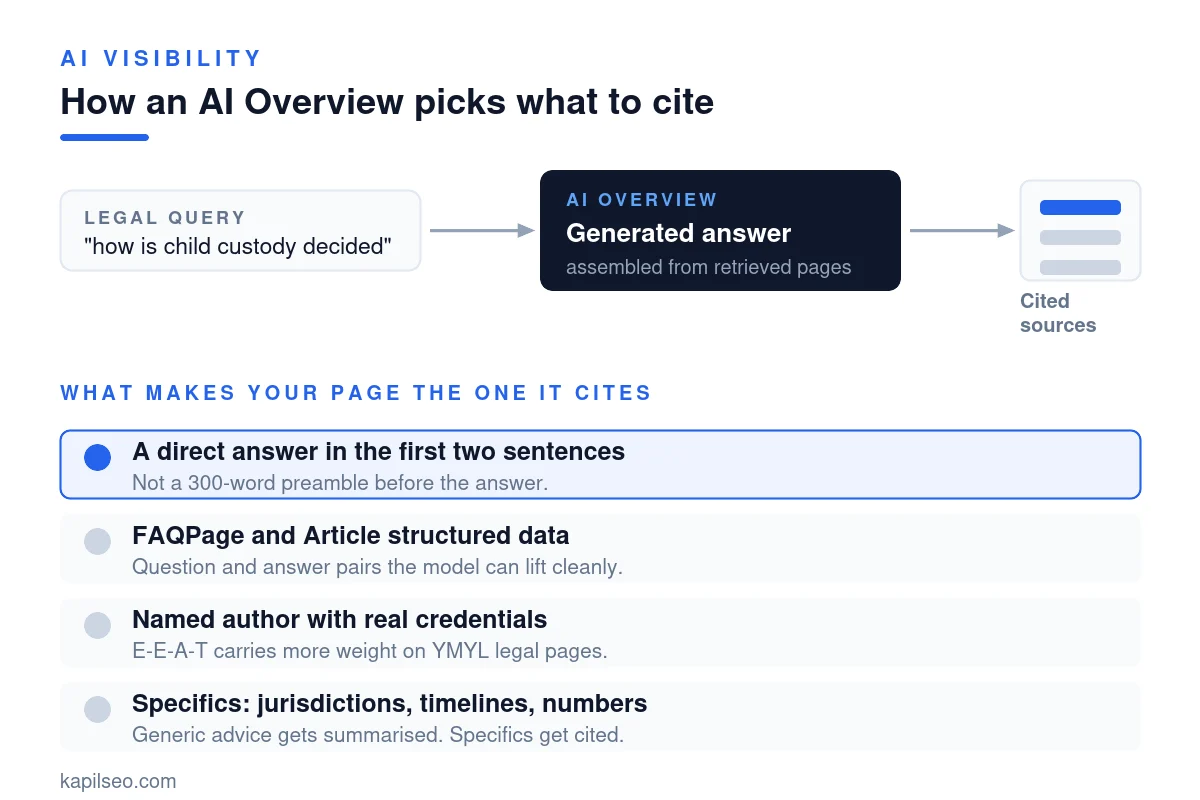
Legal is the worst-affected niche for AI Overviews, at roughly 78% of queries. Your informational articles will increasingly be summarised above the results rather than clicked. The response is not to stop writing them, it is to write them so that when the summary appears, your firm is the source named in it. Four things move this:
- Answer in the first two sentences. Lead with the direct answer, then explain. A page that buries the answer under three paragraphs of preamble is harder to lift a clean quote from.
- Structured data. FAQPage and Article schema, plus Person schema on attorney bios. Question and answer pairs are the easiest format for these systems to extract.
- Named, credentialed authors. The same E-E-A-T work that helps YMYL rankings helps citation selection, because both systems are trying to identify who is qualified to answer.
- Be specific. Jurisdictions, timelines, actual dollar ranges, procedural steps. Generic advice gets absorbed into a summary with no attribution. Specific claims get cited back to their source.
Track it monthly by running the same fifteen to twenty client questions through ChatGPT, Google’s AI Mode, Gemini and Perplexity, and logging whether the firm was named and which pages were cited. It takes about forty minutes and it is the only consistent measurement available right now.
What this looked like on a real legal client
A Canadian legal services firm on a newer, lower-authority domain. The brief was ordinary: build organic visibility from close to nothing, in a competitive local market, with AEO and GEO tracked from the start rather than bolted on later.
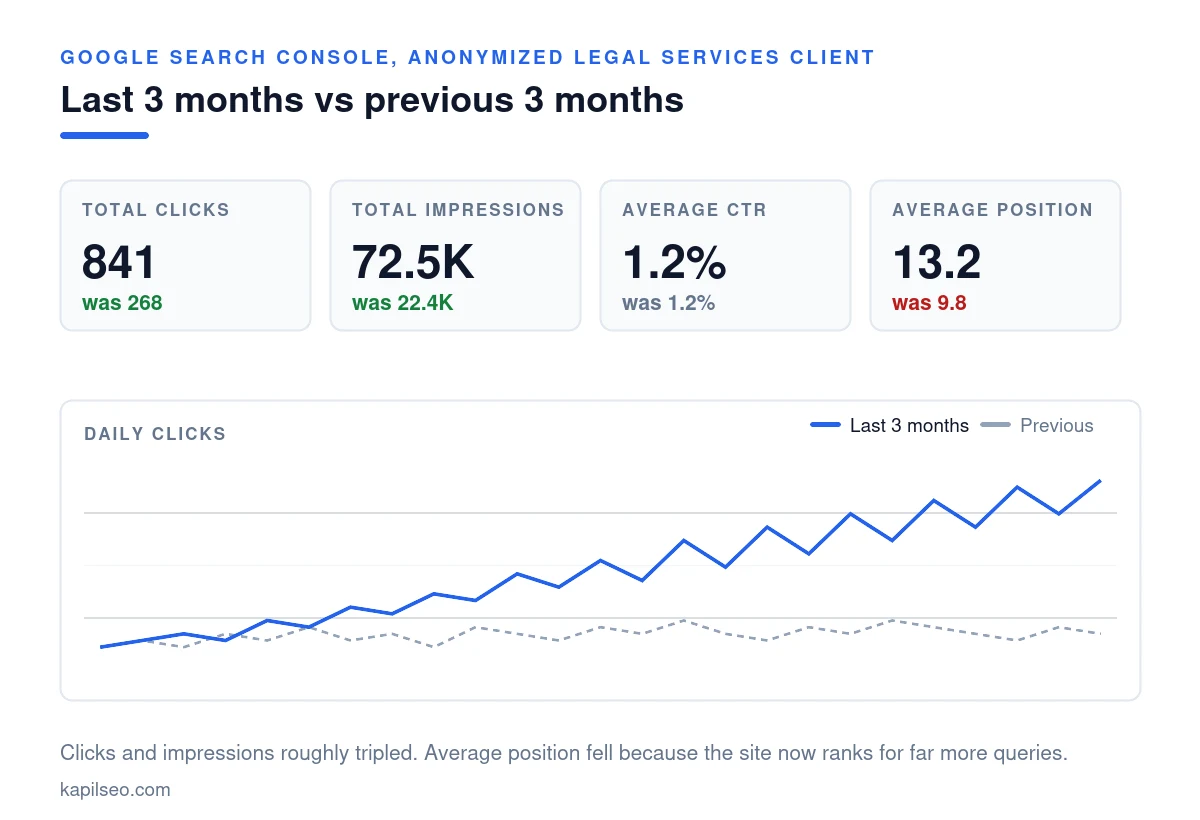
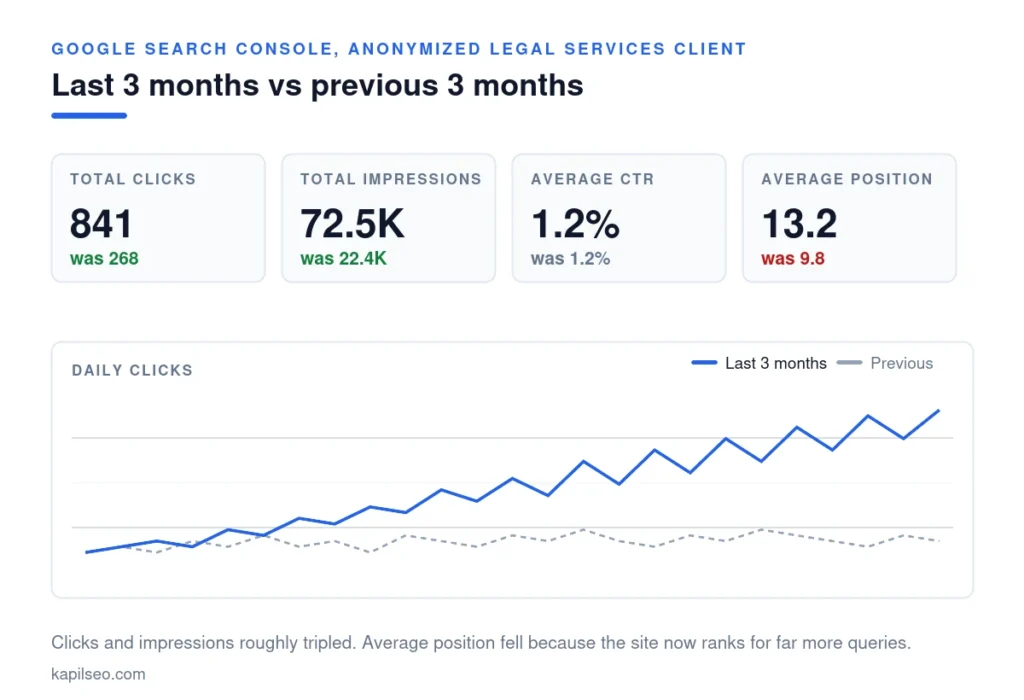
Comparing the most recent three months against the three before, Search Console shows clicks up from 268 to 841 and impressions up from 22.4K to 72.5K. Both roughly tripled. In GA4 over the same work, total sessions rose 82%, engaged sessions rose 133%, and organic sessions rose 75%.
The number I want to draw attention to is the one that got worse. Average position moved from 9.8 to 13.2. A vendor would leave that out. It happened because the site went from ranking for a narrow set of queries to ranking for a much wider set, most of them new and initially positioned lower, which drags the blended average down while clicks triple. Average position is a mix, not a score. If someone shows you a report where every metric improved, ask which ones they excluded.
On the AI side, tracked monthly from the start, the firm went from zero presence to being named and cited across ChatGPT, Gemini, Google’s AI Mode and AI Overviews, with citations appearing several weeks before the corresponding rankings caught up. The month-by-month figures for that project sit alongside my other work in the case studies.
One honest caveat: this was a legal services firm rather than a dedicated family law practice. The mechanics transfer directly, since the YMYL constraints, the local intent and the AI Overview pressure are identical, but I am not going to claim a family law result I do not have. The same engagement, viewed from the personal injury angle with the paid-click math alongside it, is in my post on SEO for personal injury lawyers.
Do it yourself or hire someone? The actual math
Almost every guide on this topic is written as if your time is free. It is not, and for a family lawyer it is unusually expensive.
Doing this properly takes something like ten hours a month once you know what you are doing: content, profile maintenance, directory work, monitoring, and the AI tracking above. At a billable rate of $350 an hour, those ten hours represent $3,500 of billable time. Even assuming you only realise half of it, because nobody bills every available hour, that is $1,750 a month of real cost.
Against that, a freelancer in a Western market runs roughly $800 to $2,500 a month, a specialist agency $2,500 to $10,000, and an experienced freelancer working remotely from a lower-cost market $300 to $1,500. For most practices at or near capacity, outsourcing is straightforwardly cheaper, before accounting for a specialist being faster and making fewer expensive mistakes.
The honest exception: if you are a new practice not yet billing a full week, your opportunity cost is close to zero and DIY genuinely is the cheaper option. Learn it, do it yourself, and hire once your calendar fills.
There is one part you cannot outsource. The legal substance has to come from a lawyer, because that is the expertise Google is looking for on YMYL pages and no writer can fake it. The arrangement that works is roughly one to two hours of your time a month on substance and review, with the technical and distribution work handled by someone else. If you want the general version of this calculation, I wrote it up separately in is SEO worth it, and the ongoing side is what my SEO services cover.
Frequently asked questions
How much does SEO for a family lawyer cost?
Roughly $800 to $2,500 a month with a freelancer, $2,500 to $10,000 with a specialist agency, and $300 to $1,500 with an experienced freelancer working remotely from a lower-cost market. Compare any of those against the billable time doing it yourself would consume, which at $350 an hour and ten hours a month is $3,500 of capacity.
How long does family law SEO take to show results?
Local map pack improvements can appear within four to eight weeks, because Google Business Profile work moves faster than organic rankings. Organic results on a newer domain take six to twelve months. If non-branded impressions have not started climbing by month four, that is the point to ask hard questions rather than waiting out a twelve-month contract.
Do I need a separate page for every practice area and city?
A separate page for every practice area, yes, because each one is a distinct search. For cities, only where you genuinely practise and can write real local content. Templated location pages with the city name swapped tend to get the whole set treated as thin content, which costs you more than the pages earn.
Are legal directories like Avvo and FindLaw still worth it?
Yes, though not primarily for links, since most are nofollow. They are worth it because prospects browse them when shortlisting, and because consistent listings act as a verification signal for local search. Claim and complete the free profiles. Be sceptical about paid upgrades, sold on visibility claims that are hard to verify.
Will AI Overviews replace my rankings for legal queries?
They already absorb a lot of informational traffic, at roughly 78% of legal queries. What they do not replace is the transactional search. Someone deciding who to hire still wants a firm, a phone number and reviews, and that decision happens in the map pack and on your site. Expect informational clicks to fall and protect the commercial pages.
About the author. Kapil Lodhi is an SEO and AI SEO specialist in Indore, India, with over four years of hands-on experience across technical SEO, content strategy, link building, local SEO and e-commerce SEO for clients in India, the United States and Canada. He has run organic and AI visibility work for a Canadian legal services firm, and the Search Console figures in this post come from that engagement.