
Off-page SEO for ecommerce comes down to one problem most guides skip. Nobody links to a product page. Links arrive at things worth citing, not at a checkout, so the real work is earning links to assets people reference and then moving that authority internally to the category and product pages that make money. Reviews, mentions and social activity support that. They do not replace it.
There is also a tactic in almost every article on this subject that Google names as spam in its own written policy. Directory submission. More on that below.
Last updated 20 September 2026.
Why off page SEO for ecommerce is different
On a blog, the page you want to rank is the page people want to link to. They are the same page. That is why generic link building advice feels easy when you read it and impossible when you apply it to a shop.
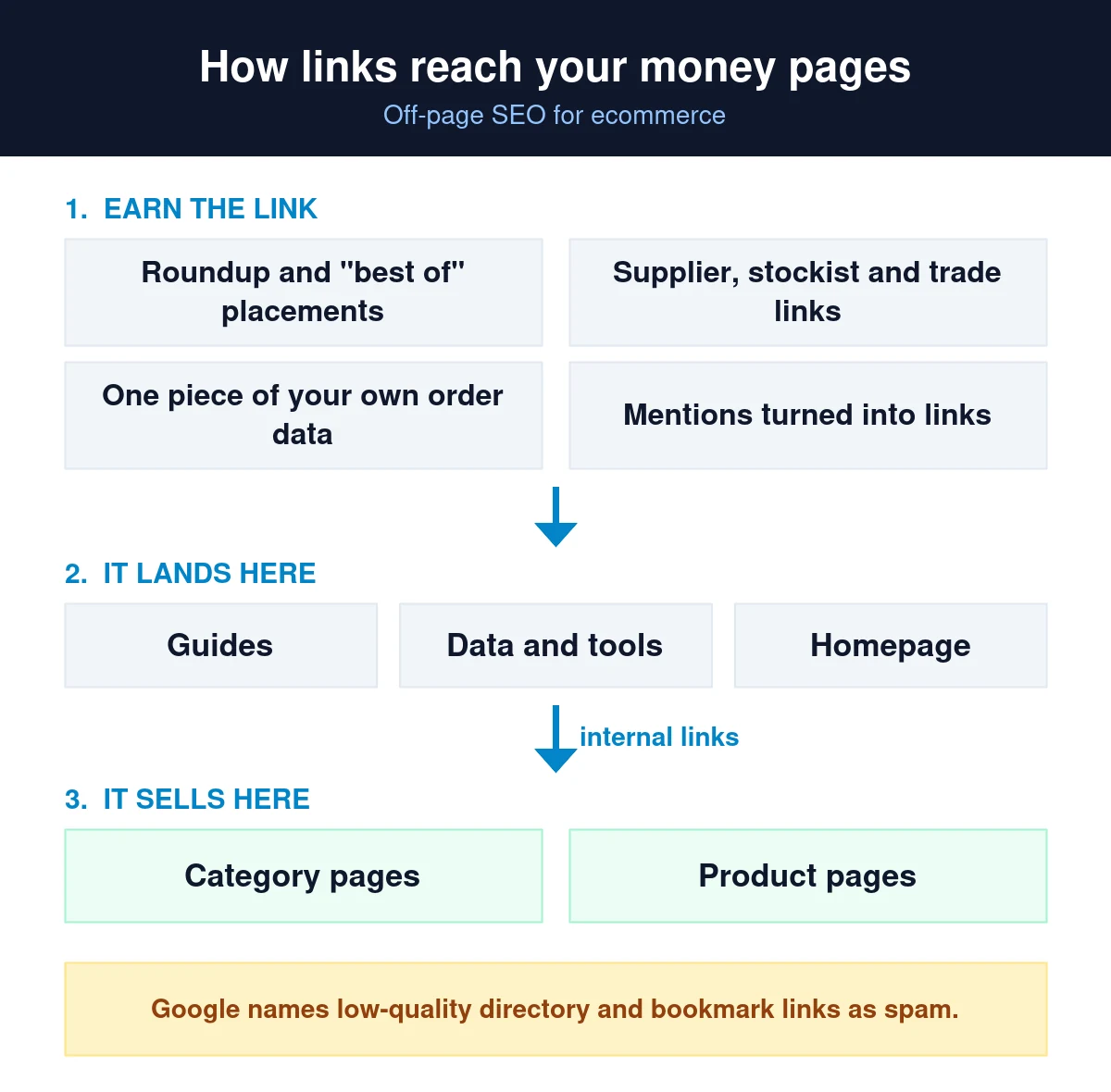
On an ecommerce site the page you want to rank is a category listing with forty products on it. There is no argument in it, no data, no story. A journalist has no reason to cite it and a blogger has no reason to recommend it. So the honest model for an ecommerce website has two steps rather than one:
- Earn links to pages that deserve them: guides, tools, original data, comparison pages, the brand itself.
- Distribute that authority internally to the category and product pages you actually need ranking.
Step two is where most ecommerce sites lose the value they worked for. A guide earns thirty referring domains and then links to nothing, or links only to the homepage. The internal route from your linkable assets down to your money pages is the cheapest off-page win available, and it costs nothing but attention. I have written separately about how many internal links a page should carry.
Four tactics that actually move ecommerce rankings
Ranked by how much return I have seen per hour spent, not by how often they appear in listicles.
1. Get into the “best” roundups
Someone has already published “best running shoes for flat feet” or “best budget espresso machines”. Those pages rank, they send buyers rather than browsers, and they link to product and category pages, which is the one link type that reaches your money pages directly. Find the roundups ranking for your category, check whether the writer accepts submissions or samples, and pitch the specific product with a reason it belongs. This is slow, it is manual, and it outperforms everything else on this list.
2. Claim the links you are already owed
Three sources most shops never check. Your suppliers and manufacturers often run “where to buy” or stockist pages and will add you for the asking. Trade associations and certification bodies you already pay for usually list members with a link. And any supplier whose product you sell has a marketing team who would rather their retailers ranked. These links are relevant, permanent, free and entirely within policy, which is a combination nothing else on this page offers.
3. Publish one thing worth citing
You are sitting on data nobody else has. What sold out fastest, what gets returned and why, what customers ask before buying, how prices in your category moved over two years. One honest piece of internal data, written up plainly, earns more links than a year of guest posts. Then link it to your categories, which is step two above.
4. Turn mentions into links
Search your brand name and find the articles that name you without linking. A short, polite email converts a reasonable share of them. This matters because of what mentions do and do not do, which is the next section.
What Google names as link spam, in writing
This is the part the roundup articles skip. Google’s spam policies list specific practices as link spam, and several of them are recommended as off-page tactics in the posts currently ranking for this topic:
- Buying or selling links for ranking purposes
- Excessive link exchanges, or partner pages that exist only for cross-linking
- Low-quality directory or bookmark site links
- Forum comments with keyword-rich links in the post or signature
- Links hidden inside distributed widgets
- Footer links spread across many sites
Directory submission is not a grey area and has not been one for years. It is named in the policy. The same goes for the classic “off page SEO sites list” you can download in thirty seconds: those lists are circulated precisely because the links are easy, which is the reason they are worth nothing.
Paid placement is allowed, provided the link is qualified. Google asks you to mark advertisements and paid placements with rel="sponsored", user-generated links such as comments with rel="ugc", and anything else you would rather not vouch for with rel="nofollow". Links carrying those attributes are generally not followed. Ecommerce sites accumulate affiliate, coupon and sponsored links faster than any other kind of site, so this is worth auditing once a year. I go into the detail in do nofollow links help SEO.
Reviews and brand mentions, without the hype
Nearly every guide on this topic tells you unlinked brand mentions are the new backlinks. Google’s John Mueller has said the opposite, fairly plainly: they are not used “for things like PageRank or understanding the link graph”.
That does not make mentions worthless, it makes them a different tool. Here is the honest split:
- A crawlable link passes ranking value. This is confirmed and it is still the thing that moves positions.
- An unlinked mention does not pass that value, but it builds the entity: it teaches search engines and language models that your brand exists, what it sells, and who says so. That is increasingly how you get named in an AI answer.
- Reviews do not work as links at all. They work as merchant and trust signals, they affect whether someone buys once they arrive, and with product structured data they can change how your result looks in search.
Treat mentions as the layer that gets you considered and links as the layer that gets you ranked. Chasing one and ignoring the other is why a lot of ecommerce brands feel visible and still do not sell.
How to measure any of this
Total backlink count is the vanity metric of off-page work. Three numbers are worth tracking instead, monthly:
- Referring domains pointing at category pages, not at the homepage. This is the number that correlates with category rankings, and almost nobody reports it separately.
- Non-branded impressions for category terms in Search Console, filtered to the category URLs. Off-page work shows up here before it shows up in revenue.
- Mentions gained versus links gained. If mentions climb and links stay flat, your outreach is working and your ask is wrong.
Give it two quarters before you judge any of it. Links take time to be recrawled and revalued, and a month of data on an ecommerce site is mostly seasonality. The structure I use for this sits in my monthly SEO report template.
Frequently asked questions
What is the best off page SEO for an ecommerce website?
Getting your products into the “best of” roundups that already rank for your category. Those pages send buyers rather than browsers, and they are the one link type that points directly at product and category pages instead of at your homepage. After that, claim the stockist and trade association links you are already entitled to, then publish one piece of original data from your own order history and link it internally to your categories.
Does directory submission still work for ecommerce SEO?
No. Google’s spam policies name low-quality directory and bookmark site links directly. The only directories worth your time are ones a customer might actually use to find a supplier, such as a trade body register or an industry marketplace, and those are worth it because of the referral traffic rather than the link.
How long does off-page SEO take to show results?
Expect four to six months before rankings move, and two quarters before you can judge the programme. Links have to be found, recrawled and revalued, and on an ecommerce site a single month of data is mostly seasonality. Impressions for non-branded category terms usually move first, which makes them a better early indicator than revenue.
Do I need to link build to product pages directly?
Rarely, and you mostly cannot. Product pages change, sell out and get retired, so links to them decay. The exception is roundup and review placements, which naturally point at products. For everything else, earn the link where it is earnable and pass the value on through internal links to the product.
Are social shares an off-page ranking factor?
Not directly. Social links are almost always nofollowed, so they pass no ranking value. What they do is put your assets in front of the people who run blogs, newsletters and roundups, and those people link. Treat social as distribution for the thing that earns the link, not as the thing that earns it.
About the author. Kapil Lodhi is an AI SEO consultant in Indore, India, with over four years of hands-on experience across technical SEO, content strategy, link building and local SEO for clients in India, the United States and Canada, including ecommerce. If you want this done on your store rather than read about it, see what I do.